My photo
Sydney, Australia
portfolio | precedents | process [since 2012]

Labels

Showing posts with label CCDN 231. Show all posts

Thursday, October 31, 2013

ccdn 231 project 2 | hand in


Rationale


The sensory/emotional experiment for project two became an elaboration on the topic of using the toilet. The process of working though the first project reinforced the importance of privacy that is a natural part of any enquiry into toilet use. It was clear that it would be more beneficial to introduce a means for further investigating the emotion of the act that was more socially acceptable. Reading material designed specifically for use in the toilet seemed an obvious solution. The result was three experiments in reading material that could alter the mood of the user whilst he or she is engaged in the act of using a toilet.

The first experiment was an exercise in translating the meaning of austerity so that the publication produced to evoke this emotion was devoid of any abstraction and became a literal translation of the word. The suggestion is that all that is required to fulfil the task of a toilet is a singular receptacle, irrespective of its age or state. Hence the rusty bucket suggests the concept of going ‘back to reality’, while the recycled paper further emphasises sustainability and social responsible design (Atfield, 2000).  The absence of text, with the exception of the word itself expresses the minimalism of austerity.

The physical as well as the mental state of comfort is bound up in this pictorial representation of the understanding of comfort resulting from project one. The responses from those interviews contained a clear message regarding the priority the participants granted to security and hygiene while using the toilet.  While comfort has in the past been more closely associated with bereavement and spirituality, these priorities are more in tune with the contemporary understanding of the word. (Shove, 2004) The locked door responds directly to the user’s need for privacy and the fur suggests the comfort of cuddly toys while the whole piece is contained in a Ziploc bag with the words confirming its fresh and clean state being all that are required to suggest comfort to the reader.

The most comprehensive experiment relates to glamour. Just as beauty is in the eye of the beholder, so too is glamour, the judgment of which is at least partly subjective. While it was used to describe sorcery previous to the twentieth century it was to become synonymous with the artifice of American cinema between the 1930s and 1950s (Dyhouse, 2011). The magazine makes use of a familiar magazine format to subtly ridicule the contemporary understanding of Hollywood-style glamour through complete redesign of the inside and outside pages of the cover. The front cover promoting the feature articles as well as the three pages of advertising are exclusively about the use of the toilet. The use of celebrity faces and well-known brands accentuates the appeal of the magazine. The reader will feel glamorous by association.

An interesting by-product of each of the experiments is humour, which may be a reflex action to the subject matter. There is a natural tendency within western cultures to allay discomfort with humour, which might explain this occurrence.

Shove,E.(2004) Comfort, Cleanliness and Convenience: The Social Organisation of Normality. London: Berg
Attfield,  J. (2000) Wild & Things. London: Berg
Dyhouse,C. (2011) Glamour:  Women, History, Feminism. London: Zed Books

Friday, October 18, 2013

ccdn 231 | project 3 final presentation

Mission accomplished...


Experience: using a toilet
Related to feeling: comfort
Venue: Toilet located at WIG 052
From previous experiments and my own extensive experience around people using toilets [1] there are several aspects that take priority for most people in order to attain an acceptable level of comfort in this situation. These are privacy, hygiene, ample supply of equipment for personal cleanliness as well as to be aesthetically pleasing and finally, an acceptable odour. Any of these four characteristics can take precedence depending on the circumstances of the event.
For the purposes of this experiment I recognised firstly that for a feeling of comfort to be evoked it would need to be tailored specifically to the person(s) undergoing the experience. Since I feel certain that Sarah Baker and Kath Foster would fall into a similar age category to that of my own, and that culturally I would estimate that there would exist between us a certain level of commonality I decided to use myself as the benchmark for the audience. I have therefore taken the liberty of filling the space with personal items that I find comforting. References to my deceased father play a role in evoking nostalgia. Interestingly a search on the word ‘comfort’ reveals multiple references to bereavement (Shove, 2004). Comfort in this instance therefore comes about by remembering life before the pain of loss.

Privacy: Most people in western cultures would agree that this part of the experience is vital in order to experience comfort. This posed a problem right away since there would be two people participating and it would be impossible to offer privacy if both used the chosen toilet at the same time so I would need to make certain I could guarantee privacy by scheduling each person’s visit and ensuring that the user felt at all times that their privacy was not in question. I have also conducted noise experiments within the room and have found there to be a good amount of sound insulation due in main to the heaviness of the door.
Hygiene: Consideration of the ways in which cleanliness is suggested in public spaces involved removing any obvious marks on the walls, physically cleaning the toilet and sink and ensuring all other surfaces were actually clean using Dettol (the faint odour of which might reinforce the idea of cleanliness). As soon as the standard lamp was installed, the room seemed perceptibly cleaner and the lighting suggested a more homely atmosphere. This might imply that homes that seem clean and organised are cleaner than institutional or public spaces.
Equipment: every item placed in the room had significant meaning to me or was specifically there to further emphasise privacy or hygiene. For example, the portraits were of me and my immediate family, all taken more than a decade ago – the one of my mother was taken in 1958. The buttons were a favourite amusement form my early childhood, the perfumes all favourites of mine as well as one of my mother’s bottles from her youth. The magazines belong to my mother-in-law and have been passed on to me. The main objective was to create an atmosphere of nostalgia and it is surprising how effective a few items of personal significance can be in achieving this. I left the items I had cleaned with the toilet brush and toilet duck to suggest a home toilet. It is very unusual to see items like these in an institutional facility. The music I played was via a Spotify playlist of Burt Bacharach music – I consider this to be the ultimate in comfortable music though not in a negative sense. It is highly palatable background music without being ‘musak’.
Odour:  as discussed I had cleaned the bathroom to ensure its cleanliness and ensure the remnants of cleaning product would instil confidence as to the standard of sanitation.  I also sprayed with a vanilla scented room spray that always reminds me of cupcakes which in turn reminds me of my childhood.
The result: The overall effect was one of homeliness and old-fashioned comfort. It was remarked on by at least one participant that even though there was evident comfort, there was also a sense of glamour which might be because we automatically assume that any obvious care in an institutional facility is immediately associated with places where toilets are glamorous.
I consider the orchestration of the experience to have been a success as there was no confusion as to how the audience perceived the experienced the space.


[1] As previously discussed I founded and was the owner/operator of a business in Australia that catered to for the powder room needs of high-end/high-profile events in Sydney, Melbourne and Brisbane. Started in May 2003 and eventually sold in August 2010, it unintentionally provided me with a means for (informally) researching the habits and behaviour of the general public when attending events in an exceptionally wide variety of situations. It also led to my being acknowledged in the Australian events industry as an ‘expert’ in toilets and evidence of this profile still exists online (e.g. http://www.abc.net.au/catapult/stories/s1530529.htm & http://www.femail.com.au/oh-de-toilette.htm)The current owners’ website is located here: www.ohdetoilette.com.au

Thursday, October 3, 2013

ccdn 231 | 'girls don't poop'

Here's an example of how an advertiser has altered the feeling around a taboo subject (smelly poos) so that it becomes acceptable and humourous. It's gone viral (11 million hits in 23 days).
I would argue that the actress who presents the ad adopts a 'regal' attitude that suggests glamour and this in turn changes the the product into something that might qualify as glamourous... thoughts?

ccdn 231 | proposal for project 2


For this project I will further explore the act of going to the toilet through a magazine/printed publication format.

I will conduct three sensory experiments involving the depiction of the act. I will alter the context in each of the three acts. I will depict the act so that in each case I produce moods of:


Glamour | Austerity | Comfort


I will choose one of these experiments and in a written rational I will justify the changes I have made by relating my practices to wider social and cultural 'structures of feeling'.

These are the slides I have produced to illustrate my proposal.*
I wanted to give the viewers a sense of how my publications would appear and feel.


Austerity

Comfort

Glamour

I will present my sensory experiments to the class. The presentation will include 2 images from each experiment and a summary of my rationale. The presentation will be no longer than 5 minutes. I will then hand in my presentation slides and 500 word justifying and relating one sensory/emotional experiment to a wider social and cultural ‘structure of feeling’ to the R:Drive.
* I was unable to present this due to illness.

Thursday, September 26, 2013

ccdn 231 | presentation of proposal for project 3

             Presentation of Proposal: Thursday 26th September

A presentation explaining the experience I intend to create. The presentation includes written visualisations of the design/experience.


Thursday, August 15, 2013

ccdn 231 | project 1 hand in

toilets

I decided to investigate further the act of going to the toilet. I have made a documentary-style video that depicts five people in the act of going to the toilet. Each individual clip represents one of the five senses. (i.e. five people, five senses). The clues are in the words which are overlaid as 'handwritten' script - taken from their written responses to my interview questions.

None of the clips involved nudity and the identity of each participant was deliberately obscured. One of the greater challenges was therefore to maintain the viewer's interest in the final edited version of the combined clips.

I did this through interesting angles, starting the crawling text at a moment where the viewer might be needing new stimuli and also when the sound of urinating commenced (so as to distract from any discomfort the viewer might be feeling).

The act of making and showing this video has almost become more important than the investigation of the actual activity. Finding willing participants was a little difficult at first but once they had seen how it was to be handled I was able to convince five people to take part.

The process was two part - firstly I asked each person to be filmed in the act of going to the toilet in a variety of locations. I then asked them to answer three questions for each of the five senses. I used this material as content for the crawling text in each of the scenes. I took the best responses for each sense and added it to the scene of the person responsible for writing it. So the words that scrawl across the screen in each room are the words of the person being filmed.

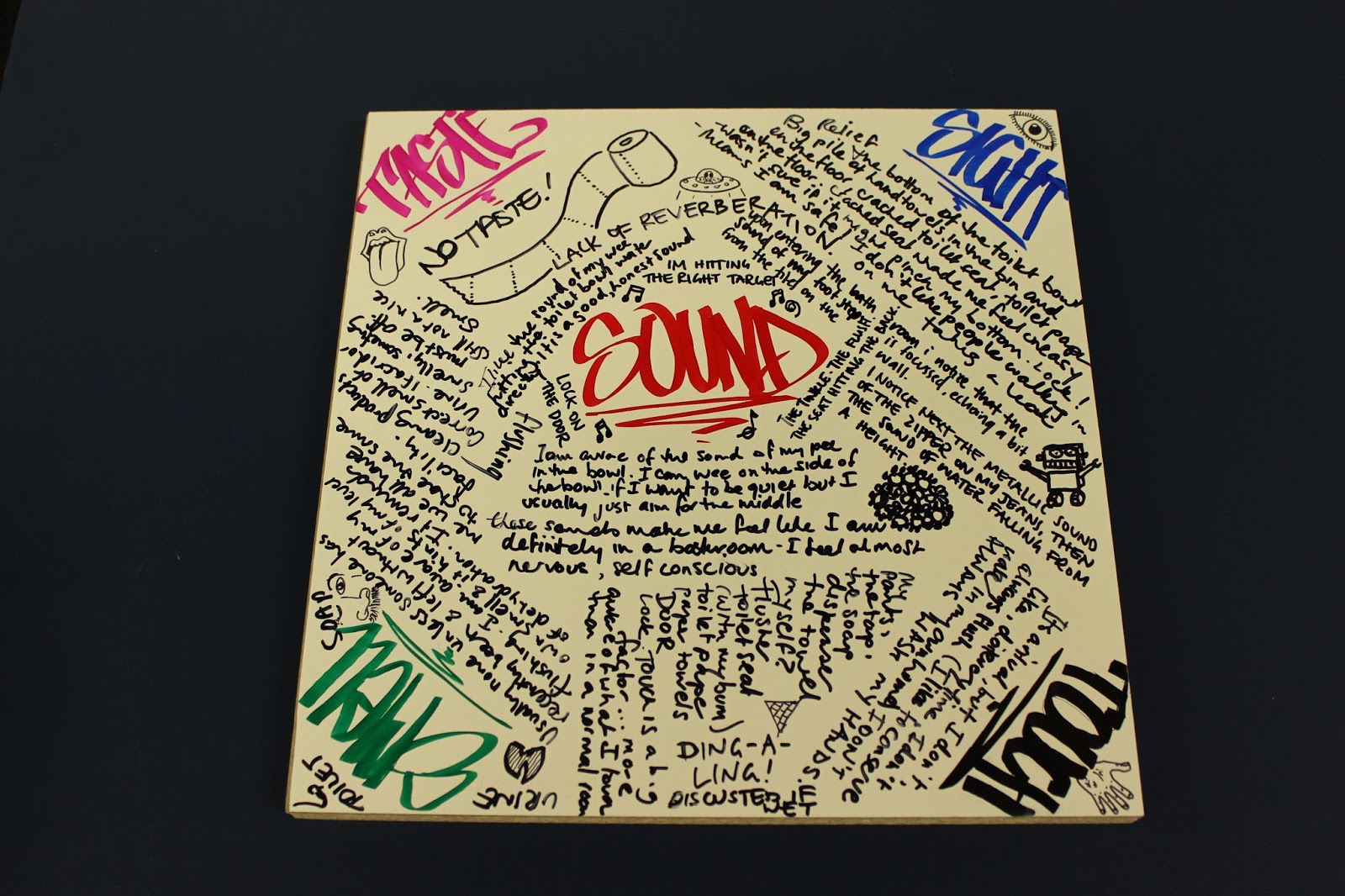
I then took the remaining material and used it for my physical hand-in. This was a piece of toilet wall covered in 'graffiti' about each of the five senses. I have therefore fulfilled the brief requirement of 500 words by submitting about 200 words in the video and the remainder of the 500 on the 'graffitti wall.

For my wall I was inspired by the cubicle on level one at the Vivian Street campus.

Here is my physical submission:

Front

I decided to use a mix of words and drawings to illustrate my board. The coloured words in 'tag' style (which are the headings for the five senses) and the 'tag' lettering is by Nikolai Scott.

And here is my video:


Note: For a short time, my video is watchable on this blog. After 31 August 2013 it will go 'Private'.


Wednesday, July 31, 2013

ccdn 231 | presentation of auto ethnography

Thursday 1st August - tutorial

A short presentation documenting three auto ethnographies (6 slides maximum).

These ethnographies must also be documented in more detail on a blog.

Each auto ethnography must include at least two images or one short video and description/analysis of at least 100 words.

I wanted to have my research revolve around the use of the toilet. I produced a video for this purpose that depicted my own personal use of my toilet at home. For privacy reasons I will not be posting this video. You are welcome to contact me directly if you would like to request the pass-code for this clip.*


The whole ritual of performing one's ablutions can be broken down into many different actions. I decided to explore the actions around the use of toilet paper, liquid soap and the tap.

Warning: It is hard for me to experience these things from anything but a personal perspective which usually relates to my former powder rooms for events supply business: Oh de Toilette.

Toilet paper - removal and preparation for use - use of 3 layered images in Photoshop

The first thing I noticed about this was the sound the roll makes as it turns on the holder. It reminds me that some bathrooms (like our own en suite) don’t even have a holder which irritates me each time I use that bathroom. I like order and it annoys me that the toilet roll seems to around the room and is sometimes hard to find.
Touching toilet paper is a highly tactile experience. It is pleasing to find it soft and disappointing if it is rough. I do not like recycled toilet paper for this reason. I prefer my bathrooms to always exhibit signs of luxury. I have also found that some budget toilet paper has an unpleasant odour, like urine, which strikes me as ironic.


Liquid soap - dispensed and used to wash hands - use of 2 layered images in Photoshop

Liquid soap has come to play a starring role in my bathrooms. Our guest bathroom at home always has expensive French soap in a dispenser available for our guests’ use. It is a matter of honour for me.  I favour liquid soaps that are rich, fresh-smelling and leave my hands feeling soft and not dried out. When I use soap like this blue one I cannot help feeling a little sad. Once again the importance of luxury and the finer things comes into play. I push the dispenser down, it works. I wash my hands with the blue then foamy soap. But it is not French. It is not up to standard.

Running water - tap turned on and hands rinsed  - use of 2 layered images in Photoshop

The act of turning on a tap can be the opening step in a multitude of actions. When it is after using the toilet it feels like a climax has been reached and the washing represents a calming period afterward. For me it is positive. Well performed it leaves me feeling refreshed and ready to move on with my day. I like the sound of rushing water and unless it is a particularly cold day, I prefer the water to be cold. I like to be thorough and find it makes me feel anxious if I am rushed through this part of the toilet ritual.

* All requests considered but not guaranteed of fulfillment.

Thursday, July 25, 2013

ccdn 231 | week 1

We've been assigned tutors - I am in Kath Foster's tutorial again.

The usual intro's ensued and we did a quick excercise based on our movement in a one hour period in the past 24 hours and using a chart to represent the movement as well as a corresponding emotion.

Here's mine:

Pattern Excercise


I think this was useful in getting us to think about being conscious of everyday acts.

When telling the class about one of the 10 minute periods I talked about taking a shower (third from left). I used purple patches arranged in an ordered pattern to describethe movement which for me is very routine and since it's a daily ritual that I can go into an auto-pilot mode to complete, I use this time to collect my thoughts and plan my day ahead, so the purple groups also represent that process. I find this deeply relaxing hence my emotional state which is uncomplicated and easy - like the blue stripes.