My photo
Sydney, Australia
portfolio | precedents | process [since 2012]

Friday, May 29, 2015

ccdn 371 | more process

I have been researching the codex and found this amazing art book that will serve as my inspiration.

Source

Source
Seriously - this is heading in the right direction.
Now I just need to work out how to incorporate my lovely velum


And my equally lovely cream linen-look card.


Tuesday, May 12, 2015

ccdn 371 | process

Paper format:

  1. concertina style (using codex-style system)
    or scroll
  2. need to research sheer paper which could be used to contain actual pages ripped from magazines 
Printing: via liquid emulsion process

Final containment: box or bound book

Ideas:

Wednesday, May 6, 2015

ccdn 371 | making an extendable magazine

I am going to redesign the magazine so that it works within the context of a 'post-digital' age.

Source


1.The process requires the reader to select the content. This would be preformed via a platform such as a website or mobile app. The reader would select the reading material they desire from the site's range or alternatively this may be managed via the app but supplied by the original publisher.


2. The content would be printed and supplied to the reader or possibly supplied as a digital file and left to the reader to print and bind.

Source

3. There would be a binder supplied to the reader which would house the printed material. The job of adding the printed material to the binder could be performed by either the reader or by the printer. The printed material would have the binding twine already in place and adding it could take place using a simple knot. The reader constructs their own 'perfect magazine'.

Source


4. Potentially there could be alternative designs that might be offered:

Other ideas


Fast back binding is where the pages are heat sealed with a tape or material strip. It looks neat and tidy, and is used often for commercial documents.
Comparison to other bindings
With this bind the book doesn't open fully, as it is stapled and glued at the edge, much like a paperback book, it cannot lie open flat, or be opened 360 degree’s. Pages cannot be added or taken away at a later date.


Source


Coptic Book Binding

A super flexible book-making process. Binding your book with an open spine–a chain stitch or a coptic stitch binding – is a great method when you have book covers that are individual boards instead of completely wrapped around the entire journal. You are basically binding all the signatures and covers together with a connected stitch that holds everything together tightly, but with super flexibility. The pages will open up completely flat and that’s a big reason why this method is so popular.There are variations to the chain stitch that could be used to incorporate subsequent files.

Source

Wednesday, March 11, 2015

dsdn 383 | project one | module one | design autopsy cards


Week two back at the grindstone and here is my first hand in for DSDN 383 - Strategic Design.

Here's the brief:

Select three pairs from the list below. Choose one product from each company and undertake a thorough visual and descriptive analysis of the two products. Document your results for each pair by designing a card in A5, that has one product on each side. Design all three cards to a professional standard.

1. Pendant light: Tobias Grau / David Trubridge
2. Bottle Opener: WMF / Alessi
3. Microwave Food Container: Tupperware / Sistema
4. Hair dryer: Babyliss / Panasonic
5. Pull along toy: BRIO / BuzzyBee 6. Brain Game: Nintendo / Xbox

And here is the result:


Wednesday, December 10, 2014

show reel | summary of two and half years of toil

This show reel has been assembled specifically for the FILM 210 application process and contains highlights of work created for my design studies since I commenced my Bachelor of Design Innovation at Victoria University Wellington in 2012.
The purpose of the video is to demonstrate the skills I have acquired and honed in that time.
The following summarises the subject/purpose for which each production was prepared, the name of each production project (featured in the order of its appearance), year of the production, and my production role in each case.
DSDN 104 | 2012 | 3D modelling/printing project | role: designer (rendered using 3ds Max)
DSDN 101 | 2013 | Cultural identity project | role: designer (using Adobe Illustrator and Adobe Flash)
DSDN 101 | 2013 | Stop-motion project for Caritas NZ | role: designer, photographer and editor (using Adobe Photoshop and Premiere Pro)
Personal project | 2014 | Time-lapse clip | role: designer, photographer and editor (using Adobe Photoshop and Premiere Pro)
DSDN 144 | 2013 | ‘Princess + Light’ project | role: designer, photographer and editor (using Adobe Photoshop)
CCDN 244 | 2014 | ‘Blocks + Boats’ project | role: designer, photographer and editor (using Adobe Photoshop and Premiere Pro)
CCDN 244 | 2014 | Datagraphy project | role: designer, photographer and editor (using Adobe Photoshop)
CCDN 332/Williment Travel (client)| 2014 | design project | role: designer, videographer and editor (using Adobe Premiere Pro) **
CCDN 331 | 2014 | ‘La Bonne’ Design Manifesto project | role: designer, photographer and editor (using Adobe Photoshop & Premiere Pro)**
CCDN 331 | 2014 | ‘The Context of the Colour’ Photo Essay project | role: designer, photographer and editor (using Adobe Photoshop)*
CCDN 331 | 2014 | Expressing a design theory group project | role: co-designer, co-camera and co-editor (using Adobe Premiere Pro)**
* Selected for GASP! Exhibition at New Zealand Academy of Fine Arts, Wellington - 2014
** Shortlisted for BDI Culture + Context end of year prize - 2014
A blog which features all work submitted for my BDI can be found at  www.bonmardi.com  (use 'Projects' tag)
Full versions of all clips featured in this show reel can be found here: vimeo.com/groups/film210


Wednesday, November 26, 2014

DSDN 142 | Project One | Inserting yourself into the code - final hand-in

Lines - open
polygons - open


ellipses - open

lines - grid
polygons - grid
ellipses - grid
lines - algorithm


polygons - algorithm

ellipses - algorithm


final composite image


Tuesday, November 25, 2014

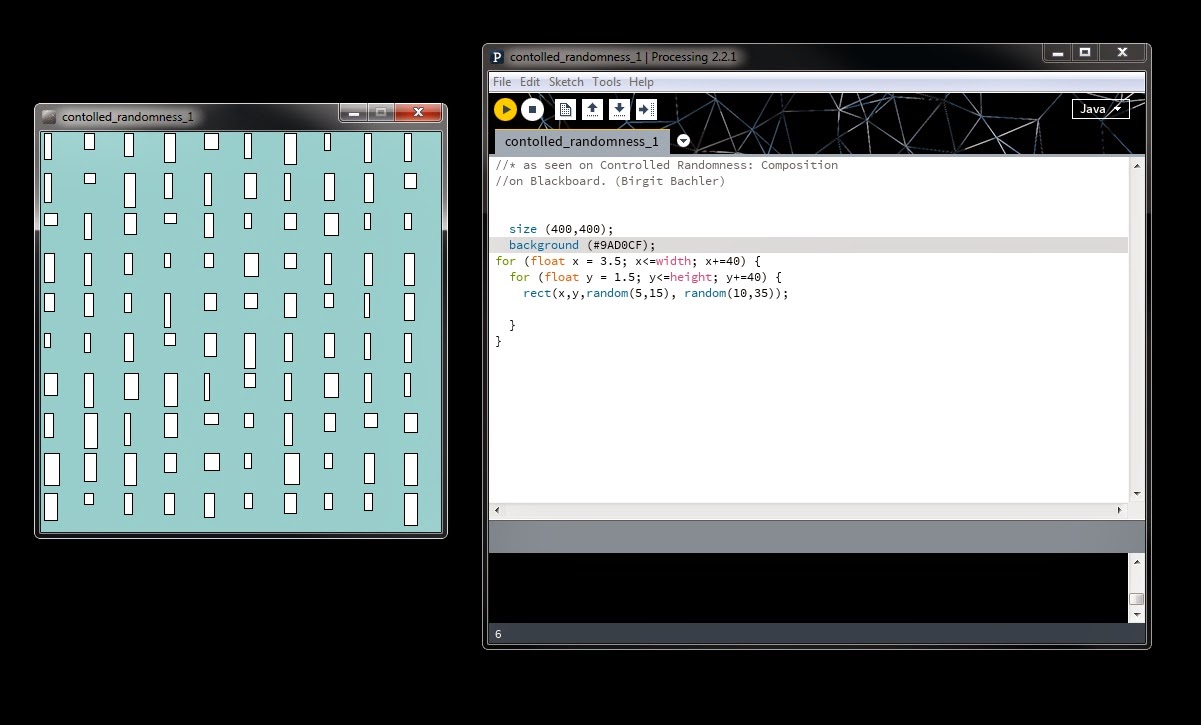
DSDN 142 | Project One | Randomness

I like this word word randomness. That we use it in coding is a little bit fun.

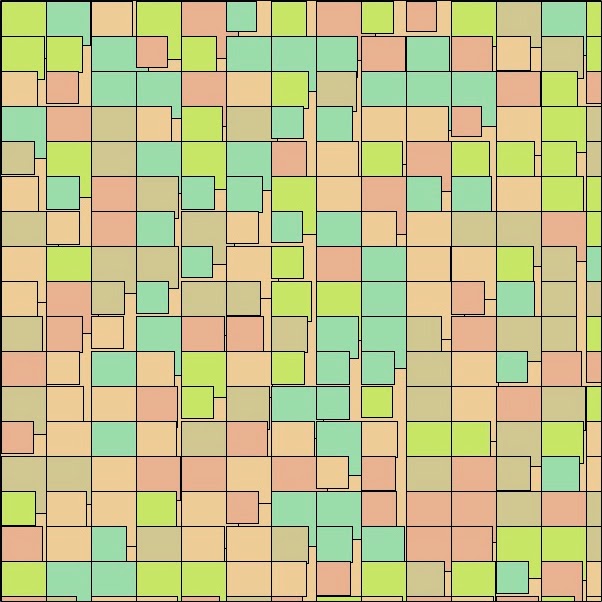
So my efforts at randomness include colour and composition as per the learning modules.

Random Grayscale

Random colour (using palette from here)

Random lines

Random boxes

More random boxes with colour background

start of finding solution to one of my nine sketches - lines_grid